
Department of Biomedical Engineering
The Department of Biomedical Engineering is an interdisciplinary department that integrates engineering principles with medical and biological sciences to address challenges in healthcare technology. The department is committed to providing quality education through a well-designed, outcome-based curriculum covering key areas such as biomedical instrumentation, medical electronics, biomedical signal and image processing, biomaterials, and medical imaging. Emphasis is placed on building strong theoretical foundations along with practical knowledge relevant to clinical and industrial applications.
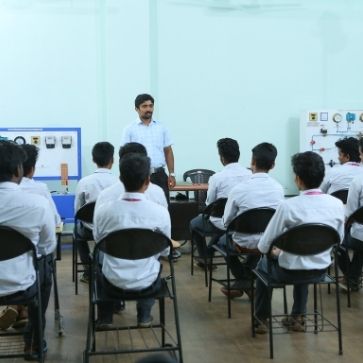
The department is supported by well-equipped laboratories that offer hands-on training with modern biomedical equipment, enabling students to develop technical competence and problem-solving skills. The department encourages research, innovation, industry interaction, and hospital exposure through projects, internships, seminars, and workshops. Focus is also given to ethical practices, patient safety, and professional development, preparing graduates for careers in medical device industries, hospitals, research organizations, higher education, and entrepreneurship.
VISION
- To become a centre of excellence in Biomedical Engineering education and research, fostering innovation and interdisciplinary collaboration to improve healthcare and enhance quality of life.
MISSION
- To build a strong foundation in biomedical engineering by combining classroom learning with real-world, hands-on experiences.
- To inspire creativity and teamwork through research and collaboration with industries and healthcare professionals.
- To shape compassionate and responsible individuals who continue learning, lead with integrity, and make meaningful contributions to society.
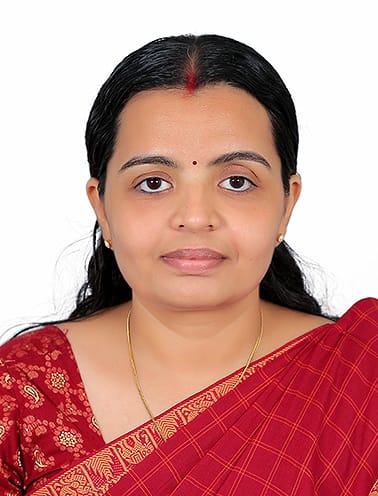
Dr. Shyama M
Head of Department
PROGRAM EDUCATIONAL OBJECTIVES (PEOs)
The educational objectives for Biomedical engineering program are designed to produce graduates who develop innovative healthcare solutions using engineering and life science knowledge, pursue successful careers or higher studies through lifelong learning, and contribute ethically and creatively to society through leadership, entrepreneurship, and socially responsible initiatives. These objectives are as follows:

PEO1
Apply their knowledge of biomedical engineering and life sciences to develop innovative solutions for the diagnosis, treatment, and monitoring of health conditions, contributing to advancements in healthcare technology.

PEO2
Pursue successful careers or higher studies in diverse engineering and technical fields by embracing lifelong learning, adapting to emerging technologies, and staying engaged with interdisciplinary innovations.

PEO3
Demonstrate integrity, creativity, and leadership by contributing to society through entrepreneurship, start-ups, or socially responsible initiatives that address real-world problems in healthcare and related domains.
PROGRAM OUTCOME (POs)
PO1: Engineering knowledge
PO2: Problem analysis
PO3: Design/development of solutions

PO4: Conduct investigations of complex problems

PO5: Modern tool usage

PO6: The engineer and society

PO7: Environment and sustainability

PO8: Ethics

PO9: Individual and team work

PO10: Communication

PO11: Project management and finance

PO12 : Life-long Learning
PROGRAM SPECIFIC OUTCOME (PSO)
PSO1
Use their understanding of medical devices, signals, and technologies to solve real healthcare problems.
PSO2
Design and assess biomedical systems that are safe, effective, and meet clinical needs.
Teaching Faculty
Dr. Shyama M
Designation Head of Department, Assistant Professor
Phone 9497685984
Email shyama.aacet@gmail.com
Qualification Ph.D
Experience 6 Years Experience Teaching + 2 Years of Industry Experience
Papers Published 4
Roles Handled Head of the Department, Asst Professor, R&D Engineer
Joining Date 2/6/2025
PG Gopika
Designation Assistant Professor
Qualification M.Tech in Biomedical Engineering
Fathimath Naziya P M
Designation Assistant Professor
Qualification BTech, M.Tech
Ashamol Joseph
Designation Assistant Professor
Qualification BTech, M.Tech
Experience 10 Years
Stenu Shaji
Roles Handled Asst Professor
Joining Date 08-04-24
Phone 7510533527
Email stenushaji96
Qualification MTech in VLSI and Embedded Systems
Experience 9 months
Shahanas C M
Designation Assistant Professor
Qualification BTech, M.Tech
Non- Teaching Faculty
Anzil Nazar
Phone 9747513938
Email ansalnazar38@gmail.com
Qualification Diploma in Electronics and Communication
Experience 8 Years
Bipin Peethu
Designation Lab Assistant
Phone 9747513938
Email
Qualification
Experience
Blessy Samuel
Designation Lab Assistant
Phone
Email
Qualification
Experience
Lab Facilities
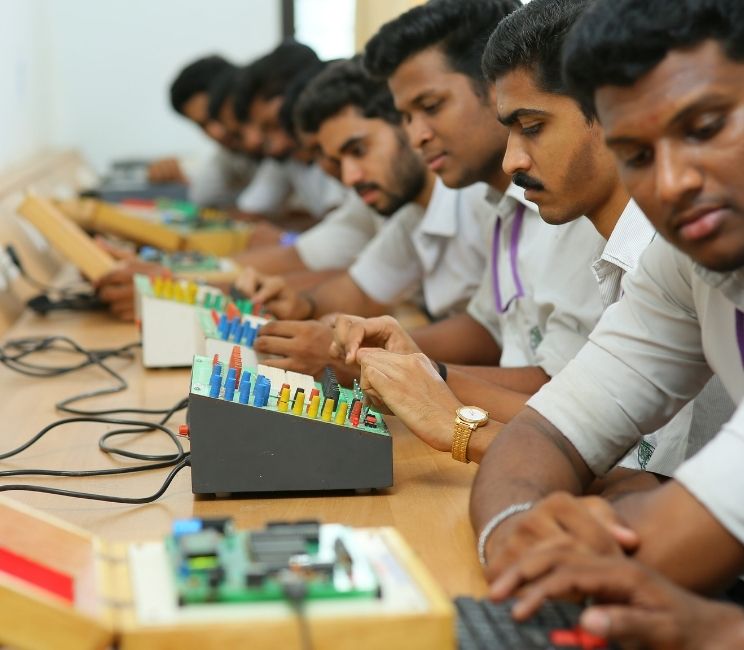
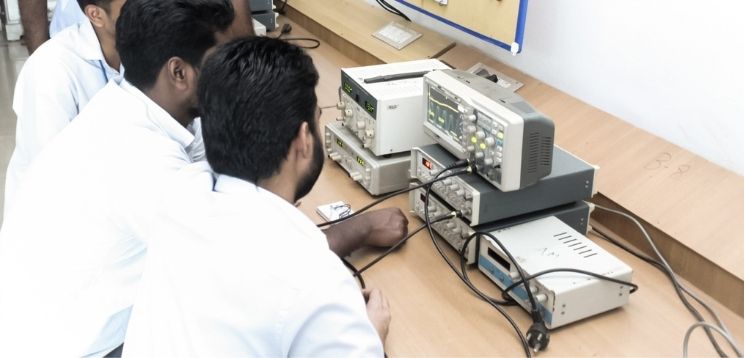
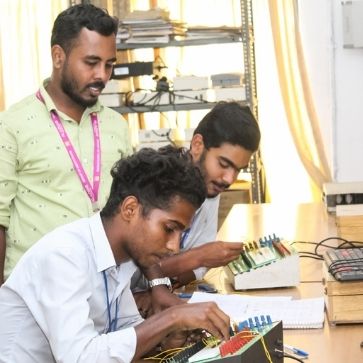
Excellent infrastructure is provided for the academic betterment of our students. To substantiate theoretical expressions, Al-Azhar has established modern laboratories that comply with the KTU regulations. The equipment, specimen and technical facilities in the lab create a superior ambience for the students to conduct experiments.
Communication Engineering Lab
. AM, FM, PM, QAM, SSB, SM
. ASK, APSK, BPSK, QPSK, PAM, PCM, PWM
Electronic Circuits Lab
Half –wave Rectifier, Full-wave rectifier, Bridge rectifier, Common Emitter amplifier.
Oscillatorcircuits-Hartley, RC Phase shift, colpitts, crystal.
Different circuits using operational amplifiers.
Microwave & Optical Communication Lab
- The laboratory is equipped with microwave benches at J band and H band, which includes expensive devices like klystron tubes, gun diodes, VSWR meter, directional couplers etc. some of the experiments are given below
- To study waveguide components.
- The characteristics of Gunn oscillator &Gun diode as the modulated source.
- Study of waveguide horn and its radiation pattern and determination of the Beamwidth.
- To study isolation and coupling coefficient of a magic Tee.
- To measure coupling coefficient, Insertion loss & Directivity of a Directional coupler.
Electronic Product Design Lab
The key features of the laboratory are
- A Printed Circuit Board Lab
- Licensed Simulation and Design Tools
- Facilities required to fabricate any B Tech level electronic products such as a) Workshop Tables, b) Bench wise c) Drilling Machines, d) Grinding machine e) Bending machine f) Sheet cutter, g) Transformer winding machine etc.
- The lab also keeps a stock of all the required items to make models of the products before actual fabrication.
DSP Lab
SCI lab
Mat Lab
Lab VIEW, KEIL, PROTEUS, MASM
Microprocessor & Microcontroller Lab
8085, 8086 Mp kit, 8051 mc kit, and various kits for interfacing experiments. This lab is used by ECE and CSE students.
Digital Electronics Lab




ISO 9001:2015 certified Institution

Affiliated to A.P.J Abdul Kalam Technological University

Approved by All India Council for Technical Education
Accredited by NAAC (National Assessment and Accreditation Council)
Call
Office 0486 222 79444
Principal 9746 144 555
Admission 9446341518 , 9496 911 119
Women Helpline 9446831000